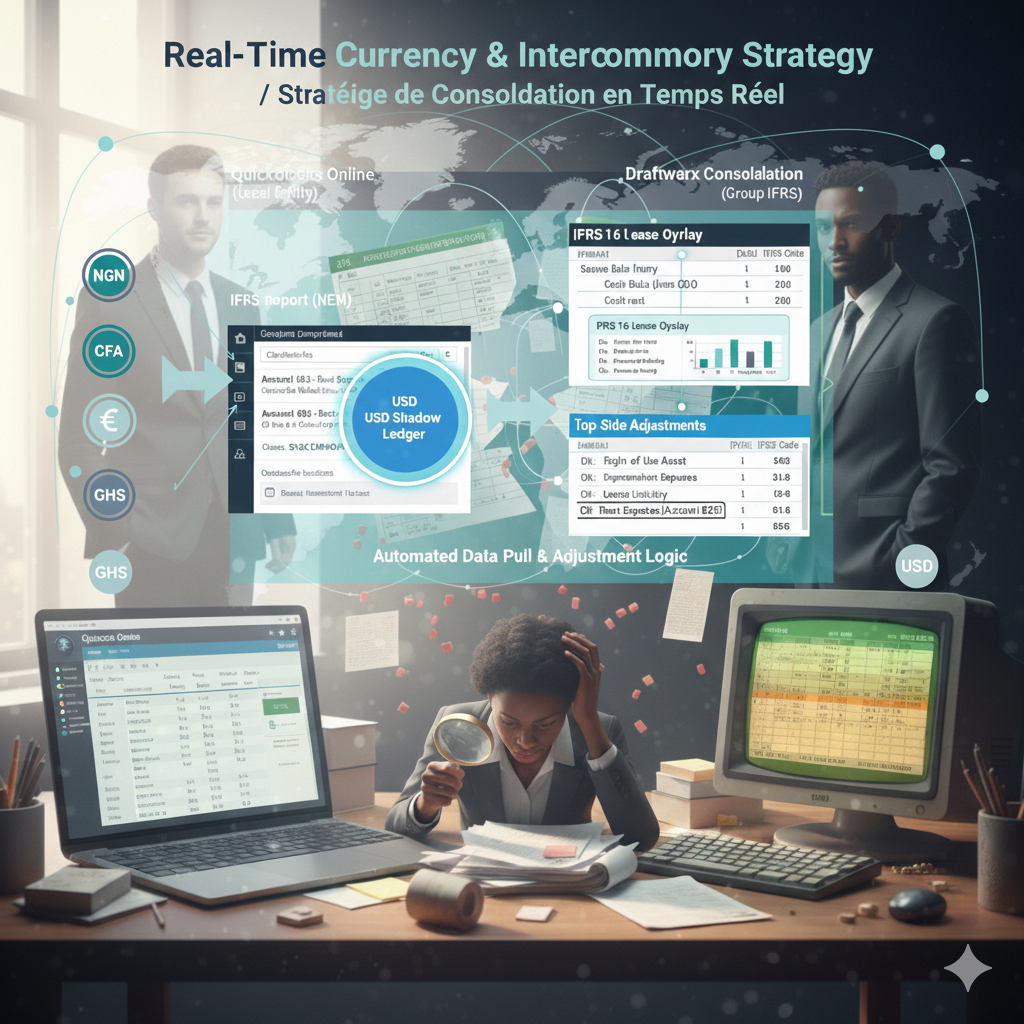
For finance leaders managing entities across borders—particularly between Anglophone and Francophone Africa—the “Consolidation Headache” is a familiar pain. You have one entity reporting in Naira under IFRS, and another in CFA under the strict, legalistic SYSCOHADA framework.
Historically, the solution has been messy: maintaining two separate general ledgers (GLs) and using a “manual bridge” in Excel to translate them at month-end.
There is a better way. By leveraging QuickBooks Online (QBO) Advanced alongside a specialized consolidation engine like Draftworx, we can move to a Unified Ledger Architecture.
1. The Flaw in the “Two-Ledger” System
Many organizations believe that to satisfy local tax authorities (like those in the OHADA zone) and global investors (IFRS), they need two separate accounting databases. This approach creates three major risks:
- Data Fragmentation: The two ledgers inevitably fall out of sync due to manual entry errors.
- The Excel “Black Box”: Complex translations for currency and intercompany eliminations are buried in spreadsheets that are prone to formula breakage.
- Audit Friction: Auditors cannot easily “drill down” from a consolidated IFRS report to the source local-currency invoice.
2. The Solution: Unified Ledger Architecture
The modern approach is to treat your accounting software as a single source of truth and use your reporting platform as the translation engine.
A. The Dimensional Chart of Accounts
Instead of separate ledgers, we build one GL in QBO Advanced that serves two masters. We use the mandatory 4-digit SYSCOHADA codes as the account numbers, but we apply Bilingual Naming (e.g., 6011 · Inventory / Achats). This allows the local team to work in their native language while the HQ sees a unified IFRS feed.
B. The “Top-Side” Overlay Method
This is where a tool like Draftworx becomes the hero. Rather than pushing complex IFRS adjustments back into the local transactional books, we apply them as an Overlay.
Consider Lease Accounting (IFRS 16). In the local ledger, the team records simple cash-rent payments to remain tax-compliant. In the Draftworx consolidation layer, the system automatically:
- Reverses the cash rent.
- Recognizes the Right-of-Use (ROU) Asset.
- Calculates Interest and Depreciation for the Group P&L.
3. Real-Time Currency & Intercompany Strategy
Consolidation isn’t just about language; it’s about math. Using a unified ecosystem allows for:
- Automated FX Translation: QBO Advanced pulls live market rates to maintain a “Shadow Ledger” in your reporting currency (e.g., USD), eliminating manual conversion errors.
- Mirror-Account Eliminations: By tagging intercompany transactions with specific “Classes,” tools like Syft Analytics or Draftworx can “net out” internal sales with one click, showing only true external revenue.
4. The Result: Audit-Ready Financials
When you move away from Excel-based bridges, your year-end audit changes entirely. You can show an auditor exactly how a CFA-denominated invoice in Abidjan became a USD-denominated asset on your consolidated Balance Sheet.
The Bottom Line
Multi-entity consolidation in Africa doesn’t have to be a choice between local compliance and global transparency. By architecting a unified ledger and using specialized consolidation platforms, you can achieve 100% compliance with 50% of the manual effort.
Engagement Tip for your Blog:
- Call to Action: “Are you still managing your group consolidation in Excel? It might be time to bridge the gap between your local tax books and your IFRS reports. Let’s talk about a Unified Ledger build.”